Choosing a memorial for a baby or infant is one of the most sensitive commissions a memorial dealer or mason will handle. This guide covers the practical decisions: shapes, carvings, inscriptions, material, and cemetery permission requirements. It is written for both families making this decision and for trade buyers who need clear, accurate guidance to advise customers with confidence and care.
Key Takeaways:
- Baby headstone sections in UK and Irish cemeteries apply smaller dimensional limits than adult sections: always confirm the specific plot size before ordering
- Heart, pillow, and curved-top tablet shapes are the most requested for infant and baby memorials
- Sandblasted carving holds detail better than laser etching on outdoor granite in UK and Irish weather conditions: the correct recommendation for longevity
- Most UK and Irish cemetery authorities require a waiting period of 3 to 6 months after burial before a memorial can be installed in infant sections
- Cemetery permission is required in all cases: no memorial can be placed on a baby's grave without prior approval from the burial authority
- Absolute Black polished granite is the most widely stocked and accepted material, though lighter granite colours are also a natural choice for infant memorials
What Shapes Work Best for Baby Headstones?
In infant memorial commissions, shape is typically the initial design choice and has a more emotional impact than in any other type. Families prefer symbols that symbolize tenderness and innocence, rather than the formality of an upright.
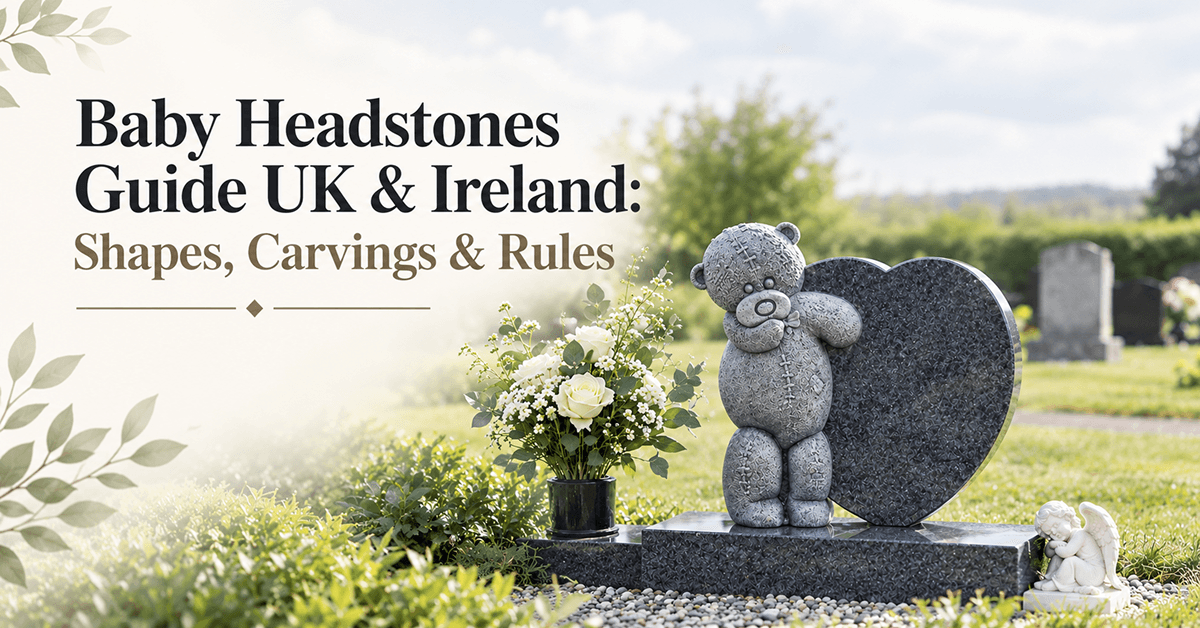
- Heart-shaped headstones are the most popular shape for baby and infant memorials in the UK and Ireland. The heart speaks its love from the heart and requires no justification. Polished black granite, softer grey tones and blue granite varieties are all used to produce different emotional registers with hearts. A heart shaped tablet in one or two of the regular sizes is a logical extension of a dealer's children's headstone range.
- Pillow or cushion shaped headstones are rounded and have slight curves to the faces. The gentle form is popularly used to represent rest and peace, and thus is especially suitable for memorials for babies. Pillow headstones are accepted in most infant cemetery sections, are very small and are set close to the ground.
- Small curved-top or flat tablets are the most straightforward shape and the one most consistently accepted across cemetery section rules. A standard size upright curved-top tablet in infant section dimensions allows for an inscription and carved design without breaking the design limits.
- Angel wing carvings on a flat marker offer a third option for families who want angel symbolism without a full figurative memorial. These are especially suited to infant sections where the height of the shapes may not be suitable.
What Carvings and Designs Are Chosen for Baby Headstones?
The memorial is most individual when it is carved with detail. The most popular designs for headstones for babies and infants are:
Stars and moons, representing the notion of there being a little light at night. Soft toys and teddy bears, especially for babies very young. Angel wings, butterflies and doves, all symbolizing the gentle passage of the soul. Flowers, especially little roses, lilies of the valley and forget-me-nots. One of the most deeply moving options for the families of stillborns and newborns: footprints and handprints.
Etched vs sandblasted carving on baby headstones: this is a question memorial dealers are frequently asked. Sand blasting removes material from the granite surface creating a physically recessed carving which remains well defined for many years exposed to the elements in UK and Irish conditions. The laser etching gives the stones a surface photographing effect that is more striking when the stone is new, but may fade faster on stones that are placed outdoors and are exposed to weather.
For permanent cemetery memorials, sandblasted carving is the correct long-term recommendation.
What to Put on a Baby's Headstone: Inscription Ideas
The inscription for infant and baby memorials is usually brief and to-the-point. The smaller the stone, the less area is available to use and thus less is practical.
A standard baby headstone inscription will comprise the baby's name, birth and death dates, a line of 2-4 words and, if desired, a symbol and/or short verse.
Common inscription approaches used by families include phrases that speak directly to the love felt, the brevity of the life, and the permanence of the memory. Phrases like "Forever in our hearts," "Loved beyond measure," "Too precious for this earth," and "Our little star, always shining" are among the most commonly requested.
For stillborn babies and those who lived only hours or days, some families choose to include "Born sleeping" or "Sleeping peacefully" in place of a conventional death date, which many find more gentle and appropriate.
The minimum is the baby's name and dates. After that it's up to personal preference, and the job of the mason or dealer is to offer choices, but not to push, at the pace the family desires.
When Can You Put a Headstone on a Baby's Grave?
One of the most frequently asked questions by families is the timing: the answer varies according to the particular cemetery or burial ground.
The majority of UK cemetery authorities will have a minimum requirement of 3 to 6 months on the waiting period for a permanent memorial to be erected in dedicated infant sections. This is a shorter waiting period than the standard adult section waiting period of 6 to 12 months, due to the smaller ground disturbance it will cause from a baby burial, but it differs between authorities.
The waiting period in Ireland is also determined by the individual cemetery authorities and also by parish graveyards. There are no formal rules on the waiting period for infant memorials at some Irish parish graveyards, but local authority cemeteries are more likely to have written guidelines. Always check with the particular burial ground before recommending a date for a family.
Do You Need Cemetery Permission for a Baby Headstone?
Yes, in all cases. A memorial may not be erected on any grave in a registered UK or Irish cemetery except on written permission of the authority for burials, no matter the size of the memorial or the age of the deceased.
Permission process is typically simpler for infant and/or baby sections than for traditional adult sections due to the lesser likelihood that the small memorial size would present site maintenance or section uniformity concerns. The application must be submitted, approved and returned in writing prior to any installation.
Faculty approval from the Diocese is required in Church of England churchyards in England and infant memorial designs are assessed on an individual basis. Slubbed or honed stone is easier to approve than a design that is complex and made out of bold colours.
In Ireland, Catholic parish graveyards will usually require a description or drawing of the proposed memorial before it will give its approval, unless managed by the local parish priest or graveyard committee. In the majority of the rural parishes, the process is informal though it is still good practice to confirm the memorial in writing prior to ordering it.
Granite Choices for Baby Headstones
Polished Absolute Black granite is the most widely stocked and accepted material for infant headstones, as it is for all memorial categories in the UK and Irish trade. The fine grain of Indian Black granite holds carved detail, particularly small footprint and handprint motifs, with greater precision and longevity than coarser alternatives.
Grey granite in a honed finish is a natural choice for families who want a softer, lighter tone for their child's memorial. It performs well in churchyard applications and tends to receive faculty approval more readily than polished black in conservation-sensitive settings.
Bahama Blue granite is occasionally requested for infant and baby memorials where the family associates the baby with the name or a calm blue palette. It carries a premium but offers a visually distinctive and quietly beautiful result.
For the full range of granite colours available, see our granite variety range.
Source Baby and Children's Headstones Wholesale
Stone Discover UK supplies children's and infant headstones in heart, pillow, and tablet formats to memorial dealers, masons, and funeral directors across the UK and Ireland.
Browse our baby's headstone range
Contact our trade team
Frequently Asked Questions
What is the standard size for a baby headstone in a UK cemetery?
Headstones are usually allowed in infant sections of UK cemeteries up to 18 inches tall and 12 to 15 inches wide, or as allowed by the authority. Pillow and flat markers are usually accepted where upright tablets are not allowed. Please check the infant section dimensional requirements with the cemetery prior to ordering.
Can you put a headstone on a stillborn baby's grave?
Yes. A stillborn baby is entitled to a burial and a permanent memorial. The inscription approach often uses "Born sleeping" with the date in place of a conventional death date. All the same cemetery permission requirements apply.
What is the most popular shape for a baby headstone in Ireland?
Heart-shaped headstones are the most popular design for infant and baby gravesites in Ireland, and in the UK. Infant memorials are also requested in Irish Catholic communities for Celtic design features such as small knotwork borders or the cross motif.
Is laser etching or sandblasting better for a baby headstone?
The long term advice for baby headstones in UK and Irish conditions is that they should be sand blasted. Creates a recessed design that will hold up for decades and decades of weathering. Laser etching provides greater detail in the photograph, but does not hold up as long on stones in the outside environment.