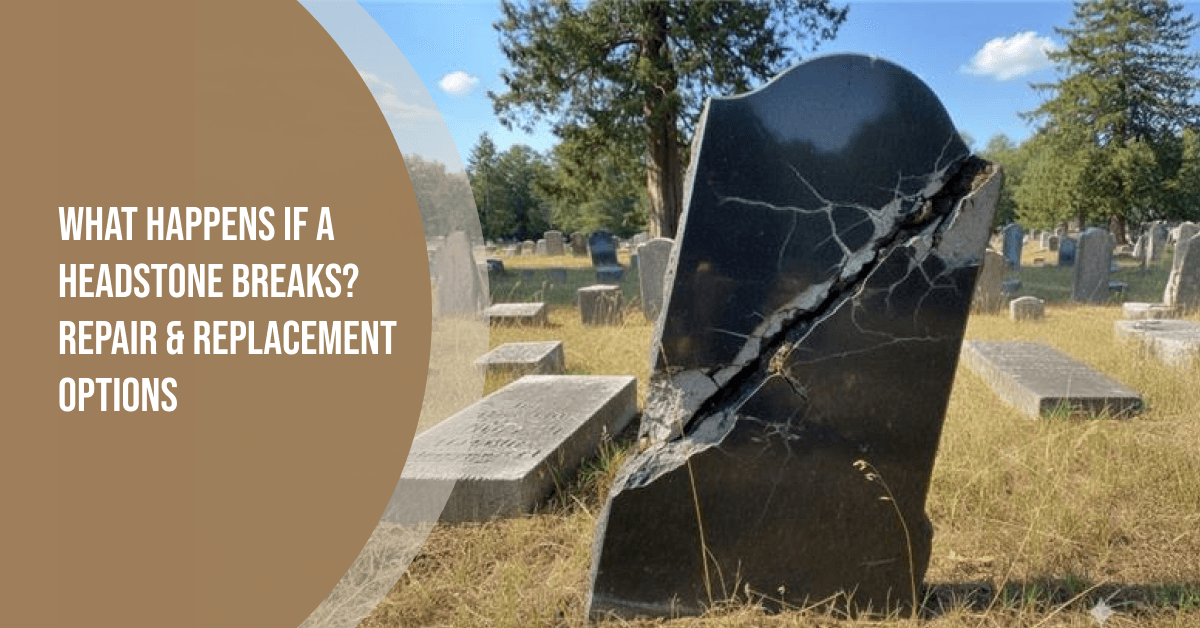
The family will initially reach out to their memorial dealer or mason when a headstone cracks. It's a time-sensitive, emotionally charged and commercially significant moment. It will be the speed at which you can determine the damage, offer solutions and either repair it or provide a replacement stone that will keep that customer for life or forfeit him or her to the next mason in your directory. This guide provides trade buyers with practical knowledge to deal with all scenarios with confidence.
Key takeaways:
- Frost cycles, ground subsidence, installation failures and vandalism are the most common reasons for heads being damaged in UK cemeteries.
- There are four damage levels and four responses: minor chips, leaning/unstable, broken in two and shattered.
- Any repair and replacement work in UK cemeteries must be carried out in accordance with the NAMM Code of Working Practice and BS 8415:2018.
- No work can take place at a cemetery without permission being given by the cemetery authority, whether it is a repair or complete replacement.
- Repair costs vary from £80 to £500 depending on the damage, replacement costs begin at £900 for a normal granite headstone.
- Dealers' most direct B2B outcome is a replacement order; you can get it right by knowing how to recommend it, price it and deliver it within a reasonable timeframe.
Why Does Headstone Damage Keep Happening in UK Cemeteries?
In the UK, granite is not affected by the climate. The most common cause of slow cracking found in older memorials is freeze-thaw cycling, as water fills the micro-fissures in the stone and expands on freezing. What begins as a hairline, over a few winters becomes a split.
The second major factor is the ground conditions. The base foundation shifts with soil subsidence especially on graves over 10 years old. If the movement of the base is not compensated by the stone, the stress is concentrated at the junction of the tablet and the base, which is usually the weakest spot. This creates leaning or tilting memorials which NAMM identifies as a safety issue on cemetery inspections.
Installation failure accounts for a significant proportion of damage cases dealers encounter. Memorials fixed with inadequate anchor systems, or not fixed at all beyond mortar, fail earlier than correctly installed stones. Under BS 8415:2018, any memorial where the highest point exceeds 625mm above ground must be capable of withstanding a horizontal load of 70kg. Stones that were installed before this standard was widely enforced frequently cannot meet it, and they are among the most common referrals for either repair or replacement.
Vandalism and accidental contact from cemetery maintenance machinery account for the remainder.
What Are the Four Levels of Headstone Damage and What Does Each Require?
Not all damage is equal. The right response depends on a clear-eyed assessment of what has actually happened to the stone. Attempting repair where replacement is needed wastes the mason's time and the family's money. Recommending replacement where a competent repair would suffice damages trust.
| Damage Level | What It Looks Like | Typical Response | Trade Implication |
|---|---|---|---|
| Minor chips and surface cracks | Edge damage, small surface abrasions, hairline cracks | Resin repair, repolishing, re-lettering | No new stone needed; service revenue only |
| Leaning or unstable | Stone tilted, base shifted, visible lean | Re-levelling, anchor replacement, refixing | No new stone if sound; BRAMM mason required |
| Broken in two | Clean or near-clean break across the tablet | Stainless steel dowelling, adhesive reattachment, repolish | Often repairable; replacement may be preferable if stone is old |
| Shattered or severely fractured | Multiple pieces, structural collapse, missing sections | Full replacement | Direct wholesale opportunity: new stone required |
The lower two levels produce the clearest business case for a replacement stone from your stock. When a family is told the memorial cannot be safely restored, they need a new one. The speed at which you can say "we have a matching granite in stock and can supply it within the week" is the difference between closing that order and losing it.
For standard replacement shapes and sizes, our in-stock granite headstones at Southampton include Ogee, Anton, and Camber Top options ready for immediate UK dispatch.
What Should a Memorial Dealer Tell a Customer to Do Immediately?
This is the conversation that shapes the whole outcome. When a customer contacts you about a broken headstone, three things need to happen in the right order.
First, they should not attempt any repair themselves. This is not just practical advice: under UK cemetery regulations, any work on a memorial within cemetery grounds must be carried out by an approved professional. A family trying to reattach a stone with household adhesive can make it structurally worse and may also create a liability issue for the cemetery authority.
Second, they need to notify the cemetery management. The cemetery needs to document the damage, especially if vandalism is involved, and will need to be informed before any repair or replacement work can begin. Some cemeteries will place a temporary safety notice on the memorial or lay it flat if they deem it an immediate hazard.
Third, contact your team. As their dealer or mason, you are the professional link between the family, the cemetery authority, and the supply chain. Getting involved early means you can manage expectations, confirm what the cemetery will permit, and position yourself to fulfil the replacement or repair quickly.
What Does UK Cemetery Permission Actually Involve for Repairs and Replacement?
It is the most nebulous area of information sources and where trade buyers can add value by knowing more than their customers.
Most cemetery authorities will only require notification for a repair, and will not need an application if the repair work is done by a BRAMM-registered mason, and the dimensions, material and design of the memorial are not changed. Re-levelling and refixing is usually a simple process to get approval for.
If a replacement is to be made, the procedure is similar to that of installing a new memorial: a formal application to the cemetery authority, confirmation that the replacement stone will comply with the size restrictions for that section of the cemetery and the stone will be installed by a BRAMM registered mason. In cases where the replacement is to be installed in a Church of England Churchyard, the site will also need to be approved by the Diocesan faculty and this will also require time for processing.
For the dealer, the crucial practical issue is whether the stone is required for a Church of England churchyard and if so then the shape and finish options are important. Profiles made of natural granite and honed or matte finishes are much more likely to be approved by the Diocese than those with high gloss polished black granite. Our Camber Top headstones guide covers the shapes and finishes that consistently perform well in churchyard applications.
How Much Does Headstone Repair Cost in the UK in 2026?
Cost is almost always the first practical question after the damage is confirmed. The ranges below reflect current UK market pricing from professional memorial masons.
| Repair Type | Typical UK Cost (2026) |
|---|---|
| Minor chip or surface crack repair | £80 to £200 |
| Re-lettering or re-gilding | £150 to £400 |
| Re-levelling a leaning headstone | £150 to £350 |
| Reattaching broken pieces with dowelling | £200 to £450 |
| Surface restoration or repolishing | £150 to £400 |
| Full replacement (standard granite) | £900 to £2,500 |
| Full replacement (bespoke or larger format) | £2,500 to £5,000 and above |
One comparison worth sharing with customers: when a stone has split in two, the cost of dowelling and reattachment (£200 to £450) can approach the cost of a modest replacement stone from wholesale stock. At that point, a new granite headstone in the same size with fresh lettering may be the more cost-effective and aesthetically cleaner result. This is the conversation where a dealer who holds good wholesale stock has a genuine commercial advantage.
For a broader breakdown of what headstones cost at retail and wholesale, our average cost of a headstone in the UK guide covers current market pricing across all types.
When Is Replacement the Right Recommendation?
There is no set threshold, however, there is a more or less consistent logic used by experienced masons. When repair is too costly (about 40-50 percent of the cost of a new stone of the same type and quality), when the stone's material is too weak to expect it to last, when many sections are missing and a colour-matched repair will be obvious and unappealing, or when the family wishes to take this opportunity to update the inscription or to add a companion dedication, replacement becomes the recommended course of action.
When a stone has broken into more than two or three pieces, or if the original stone was a lower grade material that the family has decided to upgrade, then replacement is the only practical solution. Most of the time, when this time occurs in the UK, it is when they are replaced with a premium polished granite, especially Absolute Black, as families do not want to see any work on the stone for the next 50 years.
How Do You Choose the Right Granite for a Replacement Headstone?
The replacement stone needs to work for the cemetery section, the family's preferences, and the practical realities of inscription and long-term maintenance. A few principles make this decision simpler for most enquiries.
Polished Absolute Black granite is the correct default for the majority of UK municipal cemetery replacements. It provides the highest contrast for gold leaf or laser-etched lettering, is universally accepted across standard lawn sections, and has the density to hold a polish for decades with minimal maintenance.
Grey granite, particularly in a honed finish, is the better recommendation for churchyard replacements or where the existing memorial stock on the grave used a lighter stone colour. Matching the new headstone to the existing kerb set or base stone is worth checking at the quoting stage.
For shape selection by size and cemetery type, our UK headstone size guide covers standard dimensions accepted across municipal, churchyard, and cremation section requirements.
How Can Dealers Reduce Turnaround Time on Replacement Orders?
This is the practical question most trade guides avoid entirely. A family waiting for a replacement headstone is in a state of unresolved grief. Every week the grave is unmarked is a week the dealer has an open, emotionally sensitive customer relationship.
Three things reduce turnaround time significantly.
First, hold stock. If you carry even a small range of standard granite headstones in the most common sizes, you can fulfil straightforward replacement orders from your own yard without waiting for a new factory order.
Second, know your supplier's lead times precisely. If a standard replacement from Stone Discover UK dispatches from Southampton within three to five working days, you can quote that to a family with confidence.
Third, prepare the cemetery application paperwork as soon as the family confirms they want to proceed, rather than waiting until the stone is ready to install.
Need a Replacement Headstone Quickly?
Stone Discover UK holds in-stock granite headstones at our Southampton warehouse, available for immediate UK dispatch to memorial dealers, masons, and funeral directors. Standard Ogee, Anton, and Camber Top lines are available now, with no factory wait.
Ready to Source Premium Headstones for Your UK Business?
We're a UK-based supplier with warehouses in Liverpool, London and Southampton, offering reliable headstones at trade pricing. We work with funeral directors, monument retailers and stone fabricators across the UK to build long-term partnerships based on trust and performance.
Frequently Asked Questions
Can a broken headstone be repaired without cemetery permission?
No. Any work carried out on a memorial within UK cemetery grounds requires notification or formal approval from the burial authority, depending on the nature of the work. Installing a repair or replacement without permission risks the work being required to be undone at the family's expense.
Are repairs required to be in line with BS 8415:2018?
Yes, if the repair includes any alteration to the fixing or foundation of the memorial, the end result will need to meet the BS 8415 stability requirements. This will be evaluated as a part of the repair process by a BRAMM registered mason.
What is the time-frame for replacing a burial stone after death?
Many burial boards in the UK wait 6 to 12 months after burial before they will install or replace a permanent memorial on the grounds, as this will enable the ground to settle. On a case by case basis, some authorities will accept earlier installations when damage has occurred or there is a safety concern.
What should be done if the original granite colour of the headstone is not available?
This is a real-life issue with companion stones or partial replacements. Sometimes, factory-direct suppliers may be more able to match granite colour, as they have more control over the batches of granite from the quarry. For any particular colour matching requirement please contact our trade team.
Should an old headstone be patched up or replaced?
If the repair costs are near 40-50 percent of a similar new stone, the replacement is typically the more cost effective and practical option. A new stone also provides the family with a chance to update inscriptions and begin with a new surface warranty.