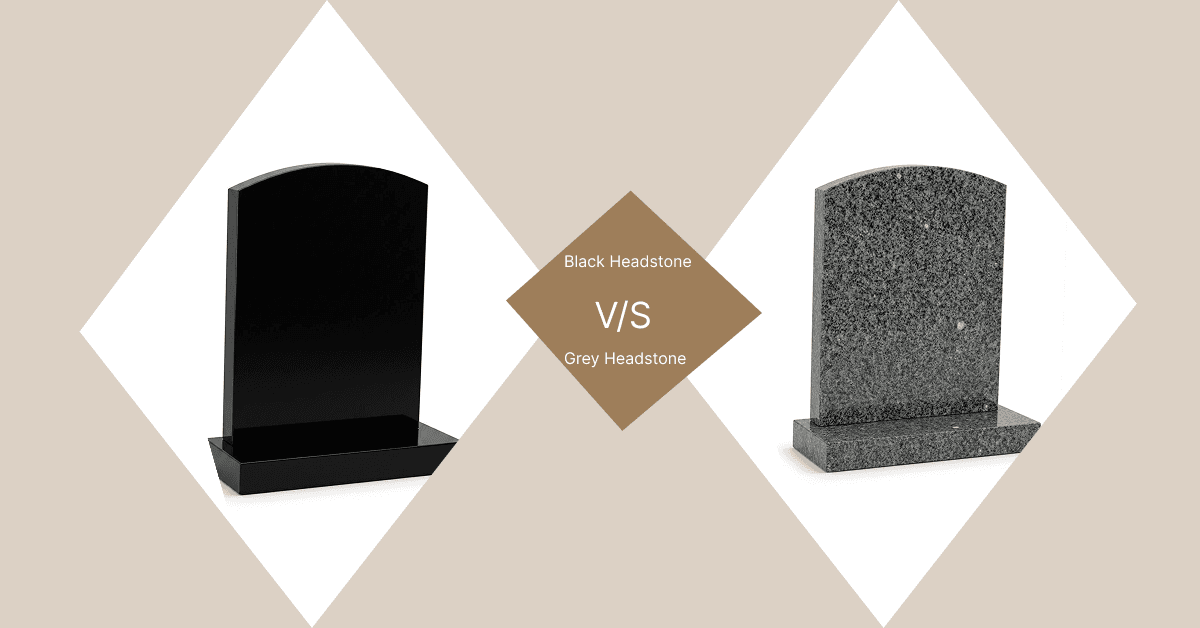
It's one of the first conversations every memorial dealer has with a customer, and one of the most common product decisions trade buyers make when stocking their showroom: black granite, or grey? Both are durable, popular and well accepted across UK cemeteries and both have been quarried, polished and used for over 100 years in the UK in burial grounds. However, the decision between the two can impact a range of factors from legibility of inscriptions, maintenance, retail pricing, regional sales performance and much more.
For years we have been supplying granite memorials to dealers all over the UK and have noticed there is a pattern, a pattern of what sells, what lasts and what cemeteries are really preferred in various parts of the UK. This guide will help you accurately advise your customers the selection between black and grey granite headstones, as well as the difference in durability, appearance, cost, maintenance and cemetery acceptance.
Black Granite Headstones: Overview
.png)
Black granite is by far the most common stone color for gravestones sold in the UK and to be expected! Besides being a long-lasting colour and contrast, jet black granite is especially distinctive for this reason, which is why it is the main stock of most of the memorial retailers today.
- Appearance: Upon completion, the black granite surface has a "gone-to-the-metal" luster, and offers outstanding contrast for engraving. No matter the type of leaf used, gold leaf, silver leaf or laser etched portraits all stand out dramatically against a black ground, a feat they cannot replicate on lighter stone.
- Durability: Granite, as a natural stone, is exceptionally strong and durable over time and, although dark colored, black granite is just as strong and durable as its lighter colored counterparts. In reality, if the monument is well-sourced and properly set, it will serve for several generations of the family it represents.
- Maintenance consideration: One potential concern with black granite is that it tends to show more visible dirt or residue than lighter granites, though regular cleaning with mild detergent, water, and a soft cloth or brush easily resolves this. This is genuinely the only meaningful drawback, and it's worth being upfront about it with customers, pollen, bird droppings, and water marks are simply more visible on a dark, reflective surface. We always remind dealers to proactively make this a topic and not let a customer find out six months after the installation. If you take care of that expectation when they're purchasing, you've almost eliminated the chances of it being a post-purchase complaint.
- Where it sources from: Absolute black granite is quarried from Telangana India, known for their fine-grained dense black granite with few mineral inclusions that are perfect for crisp lettering and photo-etch work.
Grey Granite Headstones: Overview
.png)
Grey granite has a more muted but personal appeal than black granite and is highly sought-after by families looking for a more subdued memorial and by conservation areas and traditional churchyards.
- Appearance: Grey granite comes in a variety of shades ranging from a light, silver-grey to a deeper, charcoal-gray, and sometimes has a mineral flecking, which is small crystals of quartz, feldspar and mica which reflect the light and provide a subtle texture to the stone rather than a glass-like surface as with polished black. The natural variation is an additional beauty: granite can be given a wide range of beautiful finishes, and is an ideal material for carvings or etchings, so that each memorial will have a slightly different finish, thanks to the subtle veins and flecks.
- Durability: Grey granite is just as strong and weatherproof as black granite, the difference between the two is in the mineral content and not in the strength of the granite itself. Granite is known for its hardness and resilience against natural elements, and is scratch-resistant and able to withstand extreme weather conditions.
- Maintenance considerations: Here's where grey genuinely has the edge for low-maintenance customers. In absolute terms, darker coloured granites may be more susceptible to dirt or discoloration over time, but in practice, pollution from dirt, water marks or even pollen is far less noticeable on a mid-grey surface than a polished black, so that means that the potential for stains or discoloration should be better on a grey surface in the field. This is a significant practical advantage for families that will not visit the cemetery often.
- Where it sources from: Stone Discover supplies Indian silver-grey and Impala grey granite, both quarried for consistent tone and minimal staining.
See our full granite colours range for current options.
Side-by-Side Comparison
| Factor | Black Granite | Grey Granite |
|---|---|---|
| Durability | Excellent; dense, weather-resistant | Excellent; equally dense and durable |
| Engraving contrast | Outstanding for gold/silver leaf and laser etching | Good, but contrast is softer |
| Visible dirt/staining | More visible on dark surface | Less visible day-to-day |
| Cemetery acceptance | Universal in lawn/municipal sections | Often preferred in churchyards/conservation areas |
| Typical retail position | Premium tier | Mid-range / value tier |
| Best for | Bold inscriptions, photo portraits, high-contrast designs | Traditional settings, understated memorials, low-maintenance preference |
In the United Kingdom, the typical choice for high-quality headstones is black granite, which can be one of the more expensive stone types used for memorials; however, there is also grey granite which is a more affordable option and yet still of a very high quality and durable, making it an ideal choice for families seeking value without compromising on memorial quality. From a stocking point of view, this pricing aspect is to be understood: black granite has a tendency to increase average order values, while grey granite can help to turn price-sensitive enquiries into other places.
Which Granite Do UK Cemeteries Prefer?
This is the question dealers ask us most often, and the honest answer is: it depends almost entirely on the type of burial ground.
Municipal lawn cemeteries, which are owned by local councils, do not usually have any colour restrictions. In these areas, black granite is by far the most popular option, as it is the most popular option requested by most families, although grey is also allowed.
Church of England churchyards are where colour starts to matter more. Colours that are more subdued and traditional are more likely to be appreciated by Diocesan Advisory Committees reviewing faculty applications, which will often prefer a more traditional and subdued tone because it will blend more well with the historic character of the churchyard. Some DACs prefer to use it in the honed, rather than jet black, to get faculty buy-in better than with a jet black finish which can seem too modern or too striking in a historic context. It is not strictly necessary, but is a fact to be known if you're advising a customer on an individual whose loved one is to be buried in a traditional churchyard.
Conservation areas and listed sites sometimes carry specific guidance discouraging highly reflective or dark polished surfaces. A honed grey or silver granite is almost always the safer recommendation in these locations.
Civil and non-conformist cemeteries are the most permissive, and black granite dominates by volume in these sections.
The practical takeaway for trade buyers: if you only stock one colour, black absolute granite remains the correct default; it's the highest-volume seller across the broadest range of cemetery types. But carrying a grey granite line as a secondary stock item significantly widens the range of enquiries you can convert, particularly for churchyard burials and budget-conscious customers.
We switched a portion of our stock to Stone Discover's grey granite range last year specifically to cover churchyard enquiries, and it's made a real difference. We were losing a few orders a month to dealers who could offer a 'softer' option for Diocesan applications. Having both black and grey from the same supplier, with matching kerb sets available, has simplified our ordering massively." David M., Memorial Retailer, North Yorkshire
Finish Matters as Much as Colour
The colour of granite that you have in your stock will influence the granite's finished appearance and functionality. A polished finish is shiny, intensifies colour and shows engraving well, but requires more frequent maintenance, and a honed finish is smooth and satin-like, reflecting less and is more durable and workable.
In the case of black granite, practically always a full polish is the best choice: This is the depth of the colour and is what makes the inscriptions pop. A honed finish may be more appropriate for grey granite; it helps to soften the stone's appearance, reduce the shine, and, as mentioned above, is more likely to be attractive in faculty applications of a churchyard.
We stock both polished and honed finishes across our black and grey granite ranges. If you're unsure which combination is right for a specific order, contact our trade team and we can talk through the cemetery type and design requirements before you quote your customer.
Practical Advice for Memorial Dealers
A few points we consistently pass on to trade customers when this comparison comes up:
Always ask about the burial location before recommending a colour. The practical implications of a lawn cemetery plot and a grade I listed churchyard are very different, and it is better to have them right at the quoting stage than for them to be rejected by faculty, or re-ordered.
Set maintenance expectations at the point of sale. Black granite looks spectacular when new and for years afterward, but only if the family understands it benefits from occasional cleaning.Almost all the "my headstone looks dirty" complaints are avoided down the road if the two-minute conversation takes place ahead of time.
Stock both colours if your volume supports it. A simple grey granite line is sufficient to pick up the attention of enquiries in the churchyard that would otherwise go unnoticed, even if the same type of kerb sets and vases are used.
Match the finish to the setting, not just the colour. Within the same range of shapes, such as Anton or Ogee shapes, there is a difference in the customer's needs because there are two different finishes: honed grey or polished black.
Stock Both Colours with Confidence
Stone Discover UK supplies premium black and grey granite headstones, kerb sets, and vases from UK warehouse stock, with consistent quality across both polished and honed finishes — giving your business the flexibility to serve municipal, churchyard, and conservation cemetery requirements from a single supplier.
Ready to review our granite range or place a trade order? → Browse our granite memorial stones range → Contact our trade team → +44 161 394 1594 | info@stonediscover.co.uk