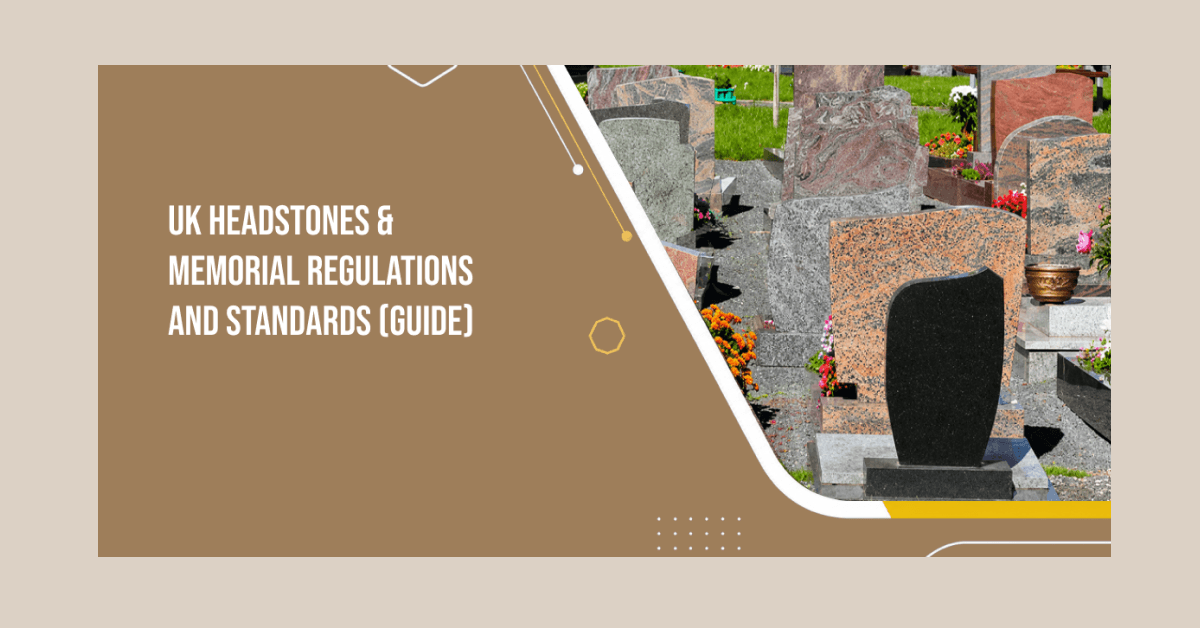
If you supply, install, or retail headstones in the UK, regulations are not optional background reading. They directly affect which memorials get approved, which installations pass cemetery inspection, and ultimately, which suppliers are worth working with. This guide covers the essentials every trade buyer needs to know.
The Core Standard: BS 8415:2018
BS 8415:2018 is the British Standard governing the stability of memorials in burial grounds. It applies to all new memorials installed at registered UK burial sites and sets out specific force requirements that every upright headstone must meet.
Under BS 8415, any memorial where the highest point exceeds 625mm above ground level must be capable of withstanding a horizontal load of 70kg applied at the apex or at 1.5m from the ground, whichever is lower. In practice, this means granite thickness, base dimensions, and foundation fixing method all need to meet defined minimum specifications.
Cemetery authorities require a certificate of conformity confirming a memorial meets BS 8415 before installation can proceed. All headstones supplied by Stone Discover UK are manufactured to the granite thickness and dimensional specifications required to satisfy this standard.
NAMM and the Code of Working Practice
The National Association of Memorial Masons (NAMM) publishes a Code of Working Practice that sets out professional standards for installation, memorial design, and after-care. While NAMM membership is not a legal requirement, most local authority cemeteries and an increasing number of private burial grounds require that memorial installation is carried out by a NAMM-registered or BRAMM-registered mason.
For dealers, this has a practical implication: if you are recommending an installer to a customer, confirming that installer holds current BRAMM registration avoids complications at the cemetery approval stage.
Church of England Churchyards: Faculty Rules

Memorials in Church of England churchyards require faculty approval from the relevant Diocese before installation. Each Diocesan Advisory Committee assesses submissions individually, but common preferences across most DACs include traditional stone profiles, muted or honed finishes rather than high-gloss polished surfaces, and no photographic reproductions or non-traditional materials.
The Anton, camber top, and ogee shapes in grey or honed black granite tend to receive faculty approval more reliably than contemporary or highly decorative styles.
Local Authority Cemetery Rules
Municipal cemeteries set their own dimensional limits for lawn sections, typically capping upright memorials at around 3'6" total height including foundation. Most accept the full range of polished granite in standard shapes without design restriction. Always confirm individual plot allowances before quoting a customer, since rules vary between burial authorities even within the same region.
What This Means for Trade Buyers
.png)
Sourcing from a supplier who manufactures to BS 8415 specifications removes one of the most common causes of cemetery rejection. It also protects your own professional reputation: a memorial that fails a stability inspection reflects on the dealer, not just the manufacturer.
Stone Discover UK manufactures all granite headstones at our own facility in Telangana, India, to consistent BS 8415-compliant thickness and dimensional standards, held in UK warehouse stock for fast trade dispatch.
→ Browse our compliant headstone range
→ View current UK stock
→ Download the 2026 trade catalogue
→ Contact our trade team — +44 1613 941 594 | info@stonediscover.co.uk