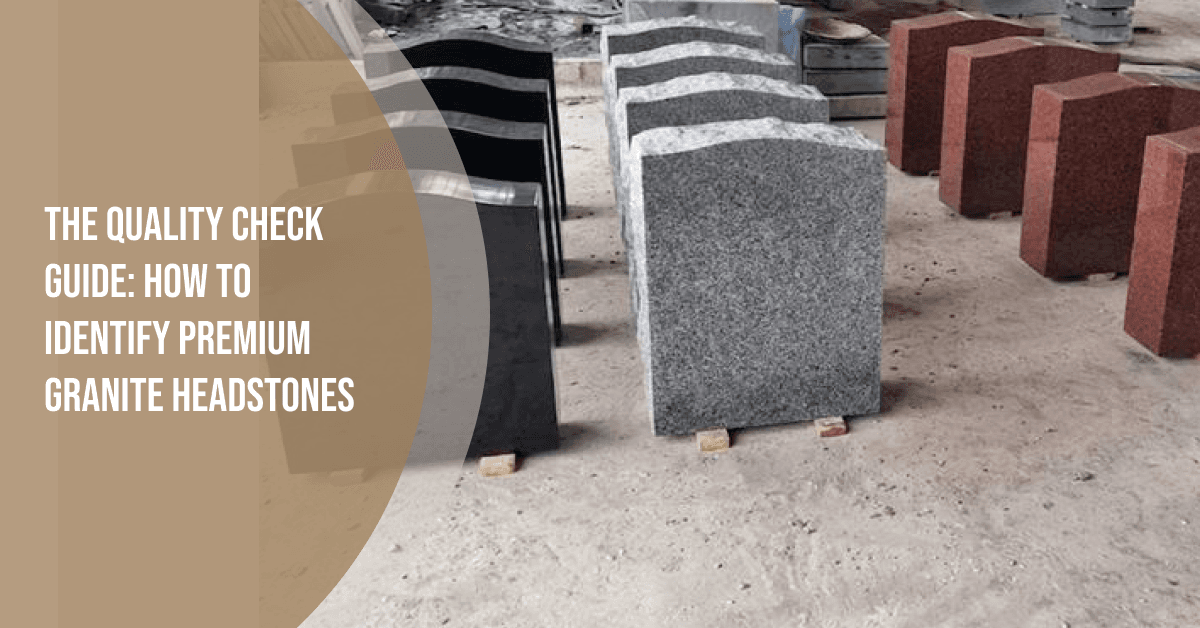
When you're buying granite headstones wholesale, you're not just purchasing stone, you're staking your reputation on it. These aren't just product failures, these are failures of a memorial, a polish, an engraving. They're things that break trade and give your business a reputation that you won't want to live with.
This is a guide for monument dealers, memorial masons, and trade buyers to help them determine if what they are purchasing is actually a premium granite or if it is some snake oil that appears that way in a catalogue picture.
Key Takeaways
- When making a decision on the quality of granite from a supplier or a consignment, make sure to perform the following six physical checks: Polish Consistency, Grain Uniformity, Edge and Corner Finish, Colour Batch Consistency, Water Absorption Rate and Engraving Clarity.
- The polish test is the quickest, most effective one, a high-quality surface should be able to mirror the light through the entire surface, and there should be no drag marks, hazy spots, or changes in the quality of the surface when viewed from various angles.
- In the UK, grain tightness has a direct impact on durability - fine uniform grain results in less surface porosity, less ingress of water and better frost resistance over multiple winters.
- Colour consistency from unit to unit is as important as colour quality on each unit - visible variation from unit to unit in a consignment causes companion set problems which cannot be resolved after installation of a memorial.
- The water absorption test is a 30-second check that you can carry out in your field, which provides much more information about the long-term performance of a stone than any catalogue description or product specification sheet.
- With a new supplier, every reputable wholesaler will be happy to provide a sample before committing to a volume purchase.
Why Granite Quality Varies More Than People Expect
Granite comes in a variety of forms and the memorial industry is not always as clear as the water. Granite is a general term for stone, and although granite will not naturally degrade even a bit over 1000 years at the proper grade, low commercial grade granite will chip, degrade and discolour over time.
The "best" of the granite types are known as A grade and are noted for its beautiful and attractive appearance, its resistance to harsh climates and the regular pattern, and the few natural defects. Granite used for commerce can have cracks, tone variations and grain irregularity that are apparent.
In the UK it makes a huge difference as memorials are placed outside during heavy rainfall, frost and anything else in between. A fine looking headstone in a warehouse can be an altogether different story three winters later in a Merseyside cemetery.
.
The 6 Checks Every Trade Buyer Should Run
1. The Polish Test
This is the first and most immediate quality signal, and it's one you can assess by eye before anything else.
Use your hands to rub over the surface, it should look smooth and glass-like, and there should be no rough or irregular spots. A good polish will have a reflective surface and when held under a light source will reflect the light nicely and create a mirror effect. Place the stone at various angles, the reflection should be the same all the way over the stone. If there is any reflection deviation, it means there are faults in the polish.
The reflection should be easy to see on the entirety of the face of the premium headstone. Any hazy areas, drag marks or a loss of shine indicates that the stone has not been finished properly. It's that simple.
Consignments have been received that looked fine in the photos, but when investigated under proper workshop lighting, showed uneven buffing on the lower third. That is a stone which has been quickly checked by the factory and would not be suitable for a family spending £1,000+ on a Memorial.
2. Grain Consistency
Granite for memorials comes in a variety of types, but the best granite is a smooth and even grain which glistens in the light when polished. If grains are inconsistent or coarse, this can be a sign of poor durability.
If you're checking out a piece, examine the crystal formation. The grain should be tight, uniform and fine throughout the entire premium Indian black granite such as Absolute Black. If there is an irregular pattern of larger crystals, or if there are visible differences in the grain density of a stone from one area to another then a lower grade block was used.
Black granite is generally a better material for gravestones than lighter granite, to withstand weathering and erosion, just as the finer-grained granite allows for more intricate carvings and greater resistance to moisture and dirt.
This matters practically: coarser grain means more microscopic surface porosity, and more porosity means more water ingress over time.
3. The Edge and Corner Check
Quality shortcuts are most likely to be noticeable along edges and structural weaknesses are most likely to be apparent first along edges.
All chamfered or rounded edges and corners should be straight and even (depending on design) on a premium headstone and should be consistent along the entire headstone. Slide your finger down each side. Any bumps, chips or imperfection on the chamfer width is a warning of hurried work.
Ensure the bottom of the stone is paid special attention, as it is usually installed in the foundation. Some lower grade manufacturers will spend less effort on the base, assuming that it will not be noticed. The overall quality of production for this particular order is often indicated by the base work, which may be rough or uneven.
These details allow you to know if a manufacturer puts in the effort to build quality into the entire stone product or if they only put effort into the face that looks good in pictures and the base plate at Stone Discover UK would be treated with the same level of care.
4. Colour Consistency
Consistent colour is one of the hallmarks of A-grade granite. Variations or blotches often suggest a lower grade, which could impact the visual appeal of finished memorials.
This is especially important when you're ordering multiple pieces of the same granite variety. If you're ordering a consignment of ten Absolute Black ogee headstones, they should all read as the same black when placed side by side. In premium supply, colour variance across a batch should be barely perceptible.
Where it becomes a real problem is with companion sets and kerb sets, products where two or more pieces will sit next to each other permanently. A noticeable colour difference between the main headstone and the kerb surround is something families notice immediately, and it's a complaint that's very hard to resolve once a memorial is set in a cemetery.
5. The Water Absorption Test
This is a practical field test that costs nothing. Drip a bit of water on an opposing (usually back face or base) of the stone and observe the results.
Quality granite should not stain and if lemon juice does stain it, it indicates that the granite is porous or poorly polished. The same should be true with plain water; on a dense well fired granite the water should bead or run off relatively fast. If it absorbs and leaves behind a dark wet spot that takes longer to dry, then this stone has more porosity than optimal and will stain and crack more easily in the future because the water penetrates the stone.
The test is very useful when considering new suppliers or unknown granite types. This takes 30 seconds and conveys more information than any catalogue description.
6. Engraving Clarity and Depth
This is important to dealers who offer pre engraved memorials or who wish to determine the quality of the stone to receive later engraving.
In the UK, inscriptions are traditionally cut into granite by sand blasting; and the resulting quality of the engraved design is directly proportional to the hardness and consistency of the stone. Poor granite has a low density, imperfections and inconsistencies which reduce the sharpness and cleanliness of the material when cut or polished and are also the case of sand blasted engraving. On lower grade stone, lettering may have a slightly fuzzy outline around the edges, may not be in sharp focus or may have the detail motifs slightly micro-chipped around the lettering.
Engraved letters/letters on a premium stone should have crisp, clean walls, and be uniform in depth. If you're assessing pre-engraved stock, hold the stone at an angle to a light source, shadows cast by the lettering should be sharp and uniform. “Blurred” or “feathered” edges should be a quality red flag. See our granite variety.
What to Ask Your Supplier
Quality checks are only part of the picture. If you're evaluating a new wholesale supplier, these questions cut to the heart of what you're actually buying:
"What grade of granite do you supply, and can you confirm it in writing?"
A supplier who can't give you a clear answer here is one to approach cautiously.
"Where is the granite quarried, and who manufactures the finished pieces?"
All of our headstones at Stone Discover UK are crafted in India by skilled stone workers using premium Indian granite, sourced from trusted quarries, finished in our dedicated manufacturing unit, and quality-checked before export. We're transparent about this because it's the foundation of consistent quality.
"Do you offer a warranty?"
Providers that offer a warranty on their memorials back up their words with a commitment and confidence in their granite. A supplier who won't stand behind their product with any form of guarantee is telling you something important.
"Can I see a sample batch before committing to a full order?"
This is standard practice for serious trade buyers, and any reputable wholesaler should facilitate it without hesitation.
A Note on Granite Colours and What They Tell You
There are various types of granites and each one has different quality aspects, so it is important to have them defined per product line.
In the UK, the most expensive headstone material is usually black granite, for its exceptional durability, its striking appearance, and other special sourcing requirements. The standard grey granite is a better value for money and has good qualities and long-lasting durability.
We have Absolute Indian Black, Bahama Blue, Indian Aurora, Indian Impala, Imperial Red, Light Grey and a selection of imported varieties such as Black Pearl and Olive Green at Stone Discover UK. Every colour has its own grain characteristics and quality indicators and we're happy to take trade buyers through what we are looking for in any colour before they order.
The Bottom Line for Trade Buyers
Premium granite headstones do not merely look better, they also work better throughout the life of the memorial, reduce family complaints and enhance your reputation as a headstone supplier.
It takes about 5 minutes to do the 6 checks above on a physical piece, and will save you a lot of grief down the road. If you are ordering from outside, then it's just good to ask for a sample before placing a large order; and any wholesale supplier worth their salt will respect that.
If you'd like to discuss quality standards, request a catalogue, or talk through a specific product requirement, our team is available Monday to Friday on +44 161 394 1594, Email: info@stonediscover.co.uk or you can get a quote directly here.
Explore our range:
Stone Discover UK is a wholesale supplier of premium memorials headstones to dealers and masons across the United Kingdom, with warehouses in Liverpool and Southampton.
FAQs
How can you tell if granite is good quality for a headstone?
Surface polish uniformity, uniformity of grain, edge finish and water absorption are the most reliable. A real quality granite headstone is supposed to be polished all over and have no texture or variation in the polish, have tight and even grain throughout the headstone, and have sharp edges from top to bottom; plus, it should have minimal absorbency on unpolished areas. Each of the 6 checks in this guide can be carried out on a physical sample within just a few minutes, and will provide a much more accurate assessment of the quality than any photo or catalogue specification.
Why does granite quality vary between headstone suppliers?
Granite is a generic term for natural stone and refers to all the stones in the family from A grade fine-grained stone to commercial grade stone with fissures, inconsistent grain and colour. The type of block mined from the quarry, the expertise and technology used at the finishing plant, and the quality control system prior to shipment all impact the final product. It might be "Absolute Black granite" as the material in two different sources but they can behave very differently after 10 years in a UK cemetery.
What is the water absorption test for granite headstones?
Add a drop of water to an unpolished part of the stone (usually the bottom or back face) and see if it drains through the stone or forms beads and runs off. High-quality, tight-granite imperviousness to water has rapid results. If the stone takes several minutes to dry after being wetted, the granite is more porous than desirable, and will be more prone to frost damage and staining over time in UK weather conditions. This test is especially helpful when assessing a new supplier or when a new variety of granite is being used.
Does the colour of granite affect its quality or durability?
Colour and quality do not necessarily go hand in hand. A fine grain material that is dense, Indian Absolute Black granite from Khammam, Telangana is one of the more durable materials for headstones. Other granites (Paradiso or Ruby Red) are also hard and source dependent. There is a much greater variation in the quality of grey granite from different suppliers. The important factor in any colour is the grain tightness and surface density, rather than the colour.
Why does batch colour consistency matter when ordering multiple headstones?
If two or more pieces of granite are permanently placed next to each other on the same grave; a headstone and its surrounding kerb stones or a main stone and later placed companion stone; the visible colour difference between the stones becomes immediately apparent to the families. One of the most prevalent complaints in the memorial market in the United Kingdom following the installation. It is nearly always the case when a supplier buys from several runs or several factories in a consignment. This risk is greatly minimised with factory-direct supply from a single quarry source.
What does engraving quality tell you about the underlying granite?
Sandblasted lettering on premium dense granite produces crisp, clean-walled letters with consistent depth and sharp edges. On lower-grade or more porous stone, lettering can appear slightly fuzzy at the edges, show micro-chipping around fine detail, or lack uniform depth across the inscription. Holding an engraved stone at an angle to a light source is the simplest check: the shadows cast by the letters should be sharp and even. Blurred or feathered edges indicate the stone is either lower grade or was not finished to the required density before engraving.
Should I ask for a sample before placing a wholesale granite headstone order?
Yes, for any new supplier relationship this is standard and sensible practice. A physical sample allows you to run the six quality checks in this guide, assess polish consistency under proper lighting, check water absorption on the unpolished surfaces, and compare colour against your existing stock before committing to volume. Any reputable wholesale granite supplier will facilitate a sample request without hesitation. Reluctance to provide samples is itself a quality signal worth taking seriously.